
Exclusive: Surprise visit to Venezuela by top US commander for Latin America
General Francis Donovan’s historic Caracas trip signals aggressive new phase in Trump’s Venezuela strategy—just weeks after audacious special forces raid captured President Maduro
In a stunning diplomatic development that would have been unthinkable mere weeks ago, General Francis L. Donovan, the top U.S. military commander overseeing Latin American operations, made a surprise visit to Venezuela on Wednesday, February 18, 2026, marking the first American military delegation to enter Caracas since U.S. forces executed a dramatic raid that captured Venezuelan President Nicolas Maduro last month.
General Donovan, Commander of U.S. Southern Command, traveled to the Venezuelan capital alongside senior Pentagon official Joseph M. Humire, Acting Assistant Secretary of War for Homeland Defense and the Americas, for critical discussions with Venezuelan officials about security cooperation and implementing President Donald Trump’s ambitious three-phase plan to completely reshape the South American nation.
US Commander’s Surprise Visit: A New Era for Venezuela?,The extraordinary visit—first reported by Reuters—represents a seismic shift in a bilateral relationship that had been essentially frozen for years under Maduro’s virulently anti-American government. Combined with last week’s visit by U.S. Secretary of Energy Chris Wright, these high-level trips demonstrate the Trump administration’s bold strategy of wielding both military might and energy policy leverage to compel Venezuela’s total political and economic transformation.
Understanding the monumental significance of General Donovan’s visit requires grasping the extraordinary military operation that preceded it. In January 2026, U.S. special operations forces conducted what military strategists are calling one of the most daring raids in modern American history—capturing a sitting foreign head of state on his own sovereign territory.
American forces seized Nicolas Maduro, Venezuela’s authoritarian strongman who had ruled since 2013, and immediately whisked him to New York to face federal drug-trafficking charges that prosecutors had filed years earlier.US Commander’s Surprise Visit: A New Era for Venezuela?, The operation’s stunning success shocked international observers and fundamentally rewrote the geopolitical dynamics throughout Latin America overnight.
The raid’s legal foundation stemmed from longstanding U.S. indictments charging Maduro with narco-terrorism, cocaine trafficking, and corruption.US Commander’s Surprise Visit: A New Era for Venezuela?, Federal prosecutors had accused the Venezuelan president of systematically transforming his country into a criminal narco-state that facilitated massive cocaine shipments through Venezuela and into the United States, working in operational partnership with Colombian guerrilla organizations and international drug cartels.
US Commander’s Surprise Visit: A New Era for Venezuela?,Previous U.S. administrations had issued these indictments but consistently lacked either the political courage or operational willingness to actually act on them. President Trump’s decisive authorization to capture Maduro represents an unprecedented escalation in American readiness to deploy military force for law enforcement objectives against foreign leaders—regardless of diplomatic consequences or international legal questions.
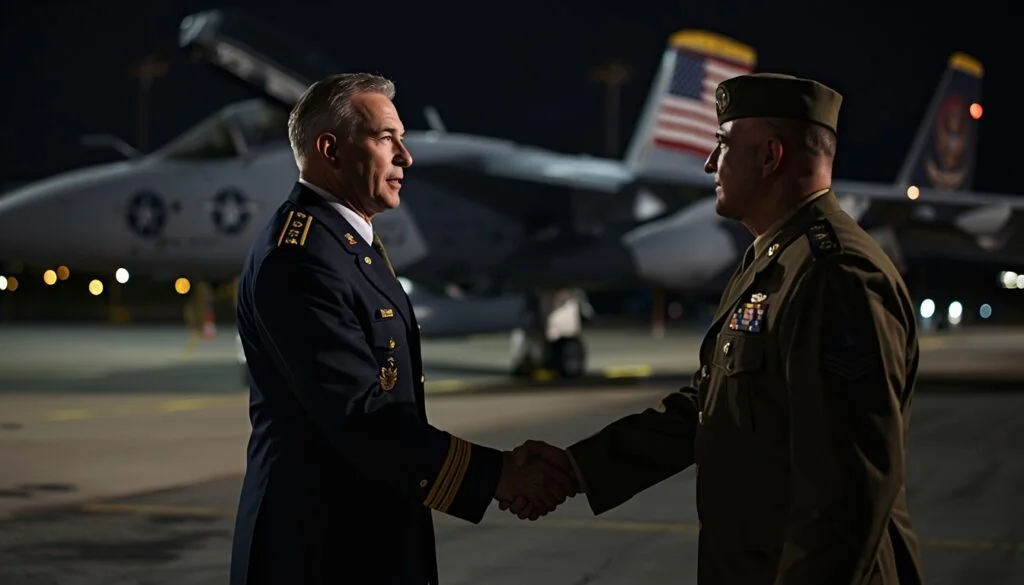
The international legal implications remain fiercely contested.US Commander’s Surprise Visit: A New Era for Venezuela?, Venezuela’s newly installed interim authorities have fully cooperated with the United States, but numerous international law scholars vehemently question whether capturing a foreign head of state violates fundamental principles of national sovereignty regardless of criminal charges. Russia, China, Iran, and Cuba have condemned the operation as flagrant illegal aggression and imperialist intervention.
Nevertheless, the raid’s operational success created immediate irreversible facts on the ground. With Maduro now in American custody facing federal trial in New York, Venezuela’s entire political landscape transformed literally overnight. Opposition figures and military officers who had operated underground or survived in exile suddenly found themselves negotiating Venezuela’s future with direct American backing and support.

General Francis Donovan and Laura Farnsworth Dogu arrive in Venezuela on United States military aircraft for historic diplomatic mission
Trump’s Three-Phase Master Plan Unveiled
General Donovan’s discussions in Caracas focused explicitly on implementing what U.S. officials describe as President Trump’s comprehensive “three-phase plan” for Venezuela—an ambitious strategy combining military pressure, energy sector cooperation, and sweeping political reform to fundamentally remake the country from top to bottom.
US Commander’s Surprise Visit: A New Era for Venezuela?,According to U.S. military’s Southern Command official statement, discussions “focused on the security environment, steps to ensure the implementation of President Donald Trump’s three-phase plan – particularly the stabilization of Venezuela – and the importance of shared security across the Western Hemisphere.”
While the Trump administration has deliberately avoided publicly disclosing complete operational details of all three phases, official statements and intelligence reporting reveal the strategic framework:
Phase One: Regime Decapitation
The January military raid capturing Maduro accomplished this foundational objective with dramatic success.US Commander’s Surprise Visit: A New Era for Venezuela?, By physically removing the authoritarian leader and placing him in American custody facing serious criminal prosecution, the United States eliminated the primary obstacle blocking Venezuelan reform. Maduro’s sudden removal created immediate political space for opposition forces and reform-minded military officials to assume interim governing authority.
Phase Two: Stabilization and Security
This current critical phase involves establishing lasting security, preventing widespread violence, maintaining basic government functions, and preventing rival armed factions from plunging Venezuela into catastrophic civil war. US Commander’s Surprise Visit: A New Era for Venezuela?,General Donovan’s visit directly addresses Phase Two objectives by personally assessing the security environment and coordinating closely with Venezuelan interim authorities to maintain fragile order.
U.S. military planners understand clearly that simply capturing Maduro without follow-through could create dangerous chaos. Various heavily armed groups—including competing military factions, socialist party hardliners, criminal organizations controlling territory, drug trafficking networks, and opposition militias—all possess substantial weapons and competing visions for Venezuela’s future. Without extremely careful management and sustained American engagement, Maduro’s abrupt removal could potentially trigger violence even worse than his authoritarian rule created.

Phase Three: Democratic Transition and Economic Reconstruction
The final ambitious phase envisions internationally monitored free elections, fundamental constitutional reforms, comprehensive economic liberalization, and Venezuela’s full reintegration into the international community and global economy. This phase will almost certainly require multiple years and demands sustained American engagement plus substantial support from international partners and multilateral institutions.
Secretary of Energy Chris Wright’s strategic visit last week addressed crucial foundational elements of Phase Three. US Commander’s Surprise Visit: A New Era for Venezuela?,Venezuela possesses the world’s largest proven oil reserves—approximately 300 billion barrels, even exceeding Saudi Arabia—but decades of systematic mismanagement, endemic corruption, and punishing U.S. economic sanctions utterly devastated the country’s once-mighty energy industry. Wright’s high-level discussions focused on rehabilitating Venezuela’s crippled oil sector through massive American investment, cutting-edge technology transfer, and invaluable technical expertise.
Reviving Venezuelan oil production to historical levels serves multiple critical U.S. strategic interests simultaneously:US Commander’s Surprise Visit: A New Era for Venezuela?, dramatically increasing global oil supply to lower consumer energy prices, generating massive revenue streams to fund Venezuela’s economic reconstruction, creating viable economic alternatives to lucrative drug trafficking, and effectively countering persistent Russian and Chinese influence throughout Latin America’s strategic energy sector.
Inside the Historic Visit: What Actually Happened
U.S. Charge d’Affaires to Venezuela Laura Farnsworth Dogu, America’s senior diplomatic representative in Caracas, enthusiastically called General Donovan’s visit “another historic day” in a detailed post on X (formerly Twitter). Her revealing account provides valuable insider perspective into the military delegation’s specific activities and meetings.
US Commander’s Surprise Visit: A New Era for Venezuela?,General Donovan strategically began his visit conducting meetings at the heavily fortified U.S. embassy compound, where he personally assessed American military personnel currently overseeing expanded embassy security facilities and operations. The United States has significantly increased its military footprint at the Caracas embassy complex following Maduro’s dramatic capture, reflecting serious concerns about potential violent attacks from hardcore Maduro loyalists, criminal organizations, or other hostile actors seeking revenge.
“He then met with the interim authorities to assess the security situation … and advance the objective of a Venezuela aligned with the United States,” Dogu stated clearly, explicitly articulating America’s overarching strategic goal: completely transforming Venezuela from a hostile adversary into a cooperative aligned regional partner.
This language reveals several critically important dynamics. First, the United States is actively consulting and coordinating with Venezuelan interim authorities rather than simply dictating unilateral terms—suggesting at least some meaningful degree of genuine partnership rather than pure military occupation. Second, American officials view Venezuela’s internal stability as deeply interconnected with broader hemispheric security, not merely a narrow bilateral issue. Third, the Trump administration is moving with remarkable speed to aggressively implement its Venezuela strategy rather than allowing the volatile situation to drift aimlessly without clear strategic direction.
US Commander’s Surprise Visit: A New Era for Venezuela?,Neither the Pentagon nor Venezuelan interim authorities disclosed which specific Venezuelan military officers or government officials actually met with General Donovan during his visit. This operational secrecy almost certainly reflects legitimate serious security concerns—Venezuelan military commanders and civilian officials openly cooperating with the United States face genuine potential assassination attempts from desperate Maduro loyalists, violent criminal organizations, or hostile foreign intelligence services actively seeking to destabilize the fragile transition.
%20(1).jpg "US military officials and Venezuelan interim government leaders discuss security situation at formal meeting with American and Venezuelan flags")
The Years-Long Diplomatic Deep Freeze That Just Thawed Instantly
To fully appreciate exactly how extraordinary General Donovan’s visit truly represents, one must understand the complete breakdown in U.S.-Venezuela diplomatic relations that preceded it. US military officials and Venezuelan interim government leaders discuss security situation at formal meeting with American and Venezuelan flags High-ranking American officials had been virtually entirely absent from Caracas for multiple years as the bilateral relationship progressively deteriorated under Presidents Hugo Chavez (1999-2013) and Nicolas Maduro (2013-2026).
US Commander’s Surprise Visit: A New Era for Venezuela?,Chavez deliberately built his entire political identity around fierce anti-American rhetoric and actions, repeatedly accusing the United States of imperialist intervention and systematically aligning Venezuela with America’s principal adversaries including Cuba, Russia, China, and Iran. He aggressively nationalized billions in foreign oil company assets, expelled American diplomats on fabricated espionage charges, and strategically used Venezuela’s substantial oil wealth to generously fund anti-American political movements throughout Latin America.
Maduro continued and actually intensified these hostile policies after assuming power following Chavez’s death from cancer. Relations reached their absolute nadir when the United States officially recognized opposition leader Juan Guaido as Venezuela’s legitimate constitutional president in 2019, while Maduro simultaneously maintained actual physical control over government institutions, military forces, and territory. This created an unprecedented bizarre diplomatic stalemate where America formally recognized one government while a completely different one exercised real power on the ground.
US Commander’s Surprise Visit: A New Era for Venezuela?,The Trump administration during its first term (2017-2021) imposed comprehensive sweeping economic sanctions specifically designed to financially pressure Maduro’s government, aggressively targeting Venezuela’s crucial oil exports and cutting off access to international financial systems. These punishing sanctions absolutely devastated Venezuela’s already struggling economy but ultimately failed to successfully dislodge Maduro from entrenched power.
US Commander’s Surprise Visit: A New Era for Venezuela?,The subsequent Biden administration (2021-2025) maintained most existing sanctions while simultaneously attempting limited diplomatic engagement to address urgent humanitarian concerns and explore potential negotiated pathways toward credible democratic elections. However, Maduro repeatedly and cynically reneged on explicit promises, conducted blatantly fraudulent elections, and dramatically intensified violent repression of opposition political figures and civil society activists.
By late 2025, U.S.-Venezuela relations had essentially ceased functioning as anything resembling a normal diplomatic relationship. The American embassy in Caracas operated with skeleton minimal staff. Absolutely no high-level official visits occurred in either direction. Communication between governments happened only sporadically through discreet third-party intermediaries when absolutely necessary.
US Commander’s Surprise Visit: A New Era for Venezuela?,The January 2026 military raid capturing Maduro instantly and completely transformed this frozen hostile relationship. With Maduro physically removed and interim authorities actively cooperating with Washington, normal productive diplomatic engagement suddenly became possible again for the first time in years. General Donovan’s visit—absolutely unthinkable just two short months earlier—now represents the emerging new normal in fundamentally transformed U.S.-Venezuela relations.
The Energy Dimension: Why Oil Secretary Visited First
US Commander’s Surprise Visit: A New Era for Venezuela?,Secretary of Energy Chris Wright’s carefully timed visit to Caracas last week strategically preceded General Donovan’s military-focused trip for calculated reasons. Energy policy represents America’s single most powerful positive incentive for Venezuelan cooperation and compliance, while military pressure simultaneously provides the essential coercive stick.
Venezuela’s battered oil industry offers truly extraordinary economic potential if properly managed with competent leadership and adequate investment. The country possesses approximately 300 billion barrels of proven oil reserves—definitively the largest in the entire world. US Commander’s Surprise Visit: A New Era for Venezuela?,However, actual production has collapsed catastrophically from over 3 million barrels per day during the 1990s golden era to barely 500,000 barrels per day recently due to systematic mismanagement, rampant corruption, chronic lack of investment, international sanctions, and devastating brain drain of irreplaceable technical expertise as professionals fled.
Wright’s detailed discussions with Venezuelan officials focused on several key strategic areas:
Massive American Investment
Major U.S. energy corporations including ExxonMobil, Chevron, and ConocoPhillips previously operated extensive profitable operations in Venezuela before Chavez aggressively nationalized their valuable assets without adequate compensation. These multinational companies currently possess outstanding legal claims worth multiple billions against Venezuela for illegally expropriated property. Wright explored potential frameworks for fairly resolving these longstanding bitter disputes while simultaneously allowing American companies to confidently return with substantial new investments.
Critical Technology Transfer
US Commander’s Surprise Visit: A New Era for Venezuela?,Venezuela’s state oil monopoly PDVSA catastrophically lost most of its essential technical expertise as highly skilled petroleum engineers, geologists, and operations professionals desperately fled the country’s economic collapse and political persecution. American energy companies can provide the sophisticated advanced technology, specialized engineering knowledge, and proven operational management needed to rehabilitate severely deteriorating oil fields and crumbling refineries.
Sanctions Relief
US Commander’s Surprise Visit: A New Era for Venezuela?,Comprehensive U.S. economic sanctions currently prevent virtually all international companies from legally purchasing Venezuelan oil or providing technology, equipment, and services to Venezuela’s crippled energy sector. Wright discussed specific conditions under which the Trump administration would systematically lift these economically crippling sanctions, immediately creating substantial economic benefits for cooperating Venezuelan authorities and generating desperately needed government revenue.
Transparent Revenue Management
US Commander’s Surprise Visit: A New Era for Venezuela?,Once oil production increases substantially toward historical levels, Venezuela’s resulting oil revenue will fund essential government operations and finance massive economic reconstruction. Wright strongly emphasized American expectations that this substantial revenue be managed with complete transparency and accountability rather than systematically stolen through endemic corruption or cynically diverted to fund anti-American activities throughout the region.

Environmental Standards
American companies operating in Venezuela will face intense pressure from environmental organizations and shareholders to implement meaningful environmental protections and substantive community benefit programs significantly exceeding the virtually nonexistent minimal standards that prevailed under Chavez and Maduro’s corrupt regimes.
The deliberate sequencing of Wright’s energy-focused visit before Donovan’s military delegation sends an unmistakably clear message to Venezuelan authorities: America genuinely offers Venezuela substantial concrete economic benefits through comprehensive energy sector cooperation and investment, but only if the country’s interim authorities fully cooperate with U.S. security objectives and strategic interests. The attractive carrot comes with the painful stick firmly attached.
Who Actually Governs Venezuela Now?
Both official U.S. government statements and international media reports consistently refer to Venezuela’s current government as “interim authorities”—but who exactly are these people exercising power, and what actually legitimizes their contested claim to govern this strategically important nation?
This fundamental question has no simple straightforward answer. The fluid situation remains constantly evolving, with various Venezuelan political actors and armed factions claiming different degrees of authority and legitimacy:
Military Leadership Holds Real Power
US Commander’s Surprise Visit: A New Era for Venezuela?,Senior Venezuelan military officers who either actively participated in or quietly acquiesced to Maduro’s capture by American forces now exercise substantial practical day-to-day power. Direct control over armed forces—including the army, national guard, intelligence services, and police—gives military leaders decisive influence over Venezuela’s fragile stability and security.
However, military rule alone provides completely insufficient political legitimacy both domestically within Venezuela and internationally. Venezuelan civil society and the broader international community reasonably expect eventual civilian democratic leadership and credible free elections, not simply an indefinite military junta regardless of how consistently cooperative with Washington’s objectives.
Opposition Political Leaders Compete
US Commander’s Surprise Visit: A New Era for Venezuela?,Venezuela’s long-suppressed opposition movement—brutally repressed for years under Chavez and Maduro—includes numerous competing political parties, civil society organizations, and individual leaders who contested fraudulent elections or operated courageously from dangerous exile. Juan Guaido, whom the United States and approximately 60 other democratic countries officially recognized as legitimate interim president from 2019-2023, represents one significant faction but notably lacks universal support even within the fractured opposition coalition.
US Commander’s Surprise Visit: A New Era for Venezuela?,Other prominent opposition figures including Maria Corina Machado, Henrique Capriles, and Leopoldo Lopez command significant dedicated followings and possess legitimate claims to leadership roles. The ongoing challenge involves somehow uniting these intensely competing factions into a minimally coherent interim government capable of managing the extraordinarily complex transition toward eventual democratic elections.
Technocratic Administrators Are Desperately Needed
Venezuela desperately requires competent professional administrators to manage absolutely basic government functions—collecting taxes, maintaining crumbling infrastructure, delivering essential services, and competently running massive state enterprises including the crucial national oil company.US Commander’s Surprise Visit: A New Era for Venezuela?, Many thousands of qualified educated Venezuelans fled the country during the prolonged economic crisis seeking opportunities abroad. Recruiting these talented professionals to return home and serve in an uncertain interim government requires credible security guarantees, competitive compensation, and sustained international support.
International Recognition Provides Crucial Legitimacy
US Commander’s Surprise Visit: A New Era for Venezuela?,The interim authorities’ contested legitimacy depends substantially on international recognition and diplomatic support. The United States, Organization of American States, and many Western democracies will almost certainly recognize whatever transitional government ultimately emerges, providing absolutely crucial diplomatic backing and economic support.
US Commander’s Surprise Visit: A New Era for Venezuela?,However, Russia, China, Iran, Cuba, and Nicaragua—all longtime strategic allies of Maduro’s anti-American regime—will very likely firmly reject the interim authorities as fundamentally illegitimate, loudly claiming they represent nothing more than a cynical U.S.-installed puppet government rather than authentic Venezuelan self-determination and leadership.
The brutally honest assessment is that Venezuela’s current interim authorities represent an awkward uncomfortable compromise between military power holders who control the guns, opposition politicians claiming democratic legitimacy, technocratic competence requirements for basic governance, and overwhelming American influence and pressure. This inherently unstable arrangement may ultimately prove unsustainable, but it represents the governing structure currently attempting to navigate Venezuela’s treacherous transition.
Latin America Watches Nervously: Regional Implications
US Commander’s Surprise Visit: A New Era for Venezuela?,General Donovan’s historic visit and the broader aggressive U.S. military intervention in Venezuela create profound far-reaching implications throughout Latin America and the Caribbean. Regional reactions vary dramatically based on current ideology, specific national interests, and existing relationships with Washington:
Supportive Pro-American Governments
Countries currently governed by center-right or explicitly pro-American leaders generally support the U.S. intervention, viewing Maduro’s forcible removal as long-overdue justice for an authoritarian dictator who systematically destroyed his once-prosperous country. Colombia—which shares an extensive porous border with Venezuela and currently hosts several million desperate Venezuelan refugees—has provided particularly strong vocal support. Argentina, Uruguay, Paraguay, and Ecuador have also expressed qualified approval.
These governments view Venezuelan stabilization as directly benefiting their own pressing security and economic interests. Potentially millions of Venezuelan refugees might voluntarily return home if the country finally achieves genuine peace and renewed prosperity, dramatically reducing enormous pressure on neighboring nations’ strained social services. US Commander’s Surprise Visit: A New Era for Venezuela?,Additionally, meaningfully reducing drug trafficking operations and organized crime networks emanating from Venezuelan territory substantially improves overall regional security.
Critical Left-Wing Governments
Leftist governments including Mexico, Brazil (depending on current electoral leadership), and Bolivia have expressed serious concerns about U.S. unilateral military intervention potentially violating Venezuelan sovereignty and establishing dangerous precedents. While carefully not defending Maduro personally—who became essentially indefensible even among ideological leftists—these governments worry about normalizing American military action against democratically elected foreign leaders based on Washington’s unilateral determinations.
US Commander’s Surprise Visit: A New Era for Venezuela?,Mexico’s government possesses particular regional influence as a major economic U.S. partner and geographic neighbor. Mexican officials have diplomatically called for respecting international law and multilateral approaches while simultaneously acknowledging that Venezuela’s humanitarian crisis clearly required some form of resolution. This carefully calibrated nuanced position allows Mexico to criticize American interventionist methods while studiously avoiding appearing to defend Maduro’s discredited regime.
Openly Hostile Allied Governments
Cuba and Nicaragua—longtime ideological allies of Venezuela’s Bolivarian socialist revolution—have vehemently condemned the U.S. intervention as naked imperialist aggression and categorically refused to recognize the interim authorities’ legitimacy. US Commander’s Surprise Visit: A New Era for Venezuela?,Both countries provided substantial security assistance and intelligence support to Maduro’s regime for many years and now face potential diplomatic isolation as their crucial Venezuelan ally suddenly disappears.
Cautious Neutral Observers
Many pragmatic Latin American countries are deliberately adopting careful wait-and-see approaches, tactically declining to either strongly support or explicitly condemn U.S. actions until the volatile situation clarifies considerably. US Commander’s Surprise Visit: A New Era for Venezuela?,These governments understandably want to maintain productive relationships with Washington’s regional superpower while simultaneously avoiding premature political commitments to a Venezuelan transition that might ultimately fail catastrophically.
US Commander’s Surprise Visit: A New Era for Venezuela?,The broader strategic question facing Latin America involves whether the dramatic U.S. military intervention in Venezuela represents a unique isolated case addressing genuinely exceptional circumstances, or whether it dangerously establishes a troubling new precedent for American willingness to routinely use military force to unilaterally remove leaders Washington subjectively deems criminal, threatening, or simply inconvenient. This fundamental uncertainty creates both powerful deterrent effects and substantial anxieties throughout the region.
Critical Challenges Ahead: The Long Difficult Road
General Donovan’s visit addresses immediate urgent security stabilization requirements, but Venezuela still faces truly enormous challenges that will inevitably require many years to adequately resolve:
Security Sector Reform
Venezuela’s military and police forces require fundamental top-to-bottom transformation. Long years of systematic corruption, deep politicization, and direct involvement in international drug trafficking have severely compromised these essential institutions.US Commander’s Surprise Visit: A New Era for Venezuela?, Building genuinely professional security forces that serve the nation and constitution rather than political factions or criminal enterprises demands extensive retraining programs, rigorous vetting processes, and comprehensive structural reorganization.
Disarming Irregular Armed Forces
Beyond official government security forces, Venezuela contains numerous dangerous irregular armed groups including colectivos (violent pro-government militias), ruthless criminal gangs controlling substantial territory, ELN Colombian guerrilla presence, and potentially opposition militias.US Commander’s Surprise Visit: A New Era for Venezuela?, Successfully disarming these heavily armed groups without triggering widespread violence represents a massive complex challenge requiring careful negotiation and credible security guarantees.
Preventing Civil War
Hardline Maduro loyalists embedded within military units or armed colectivos might violently resist the U.S.-backed transition. Additionally, bitter rival factions within the fractured opposition movement or competing military commands could potentially fight each other for political power and economic spoils. US Commander’s Surprise Visit: A New Era for Venezuela?,Preventing Venezuela from descending into catastrophic civil war requires extraordinarily careful political management, sustained economic support, and probably continued substantial U.S. military security assistance.
Economic Reconstruction
Venezuela’s economy h
as collapsed absolutely catastrophically under socialist mismanagement. Hyperinflation systematically destroyed citizens’ life savings and purchasing power. Critical infrastructure deteriorated severely. Millions of educated professionals and skilled workers desperately fled seeking opportunities abroad.US Commander’s Surprise Visit: A New Era for Venezuela?, Rebuilding a functional modern economy from this devastation will require sustained massive investment, institutional reform, property rights protection, and probably decades of patient effort.
Humanitarian Crisis Response
Millions of Venezuelans face severe food insecurity, lack reliable access to clean water and basic healthcare, and live under constant threat of violence or exploitation.US Commander’s Surprise Visit: A New Era for Venezuela?, Addressing this profound humanitarian crisis demands immediate emergency relief followed by long-term development programs rebuilding social services and economic opportunity.
Democratic Institution Building
Venezuela’s democratic institutions—including electoral authorities, judiciary, legislature, and free press—were systematically destroyed or corrupted under authoritarian rule.US Commander’s Surprise Visit: A New Era for Venezuela?, Rebuilding genuine democratic governance requires constitutional reform, institutional capacity building, training programs, and sustained international monitoring to prevent backsliding toward authoritarianism.
Combating Entrenched Corruption
Venezuela ranks among the world’s most corrupt nations, with systematic graft permeating every level of government and society. Establishing transparent governance, US Commander’s Surprise Visit: A New Era for Venezuela?,prosecuting corrupt officials, recovering stolen assets, and changing deeply embedded cultural norms around corruption represents perhaps the single most difficult long-term challenge.
The Uncertain Path Forward
General Donovan’s surprise visit to Caracas on Wednesday US Commander’s Surprise Visit: A New Era for Venezuela?,represents a critically important milestone in Venezuela’s transformation—but only an early milestone in what will inevitably prove a long, difficult, and uncertain journey.
The Trump administration has boldly demonstrated its willingness to use military force decisively to remove hostile foreign leaders and fundamentally reshape strategically important regions.US Commander’s Surprise Visit: A New Era for Venezuela?, The January raid capturing Maduro proved that American special operations forces possess the capability and presidential authorization to conduct operations that previous administrations considered but ultimately rejected.
US Commander’s Surprise Visit: A New Era for Venezuela?,However, capturing an authoritarian leader proves far easier than successfully building stable democracy and prosperity from the wreckage of failed states. American military interventions in Iraq, Afghanistan, Libya, and elsewhere demonstrate that regime change represents only the beginning of immensely complex political, economic, and social reconstruction challenges.
Venezuela’s outcome remains genuinely uncertain. The country could successfully transition toward democracy, economic recovery, and regional integration with sustained American support and competent Venezuelan leadership. Alternatively, it could descend into civil war, continued authoritarianism under different leaders, or fragmentation into competing criminal fiefdoms despite American intervention.
US Commander’s Surprise Visit: A New Era for Venezuela?,What remains absolutely clear is that the Trump administration has committed America to actively managing Venezuela’s future rather than simply isolating the country through sanctions and rhetoric. General Donovan’s visit this week—combined with Secretary Wright’s energy diplomacy—signals that the United States intends to use both military power and economic inducements to shape outcomes.
The next several months will prove critical. US Commander’s Surprise Visit: A New Era for Venezuela?,Can interim authorities maintain security while preparing for credible elections? Will oil production increase substantially, generating revenue for reconstruction? Can millions of refugees be safely repatriated? Will neighboring countries support or undermine the transition?
These questions US Commander’s Surprise Visit: A New Era for Venezuela?,will determine whether Trump’s Venezuela intervention ultimately succeeds as a model for future American regional policy—or fails as another cautionary tale about the limits of military power in solving fundamentally political problems.
For now, Venezuela stands at a historic crossroads, with American generals walking the streets of Caracas for the first time in a generation. Where that road leads remains to be written.
FAQ;
- Who buys the most oil from Venezuela?
Think China, think India—the main buyers in the picture.
- What US presidents have visited Venezuela?
Just a handful over time, including Franklin D. Roosevelt and George H. W. Bush.
- 2 What US presidents have visited Venezuela?
Visits have been limited, notably by Franklin D. Roosevelt and George H. W. Bush.
- Why is America sending military to Venezuela?
- The U.S. says it’s to stop drug trafficking and enforce law actions, though critics think it’s also about control and oil interests.

